It is the last week of August, and if you drive off Bird Key toward St. Armands, you will pass the same orange construction fencing you have been passing since spring. If you drive the other direction, back toward downtown, the clubhouse site behind the gatehouse still looks like a construction lot, not a finished building with a flag on the roof. Neither of these things is news to anyone who lives here. What might be news is that both were supposed to look different by now.
Two years ago, when Bird Key Yacht Club's leadership first showed members renderings of a rebuilt clubhouse, the plan called for a soft opening in August 2026. That month has come and gone. And the Florida Department of Transportation's rehab of the John Ringling Causeway, the project responsible for the fencing, the detours, and the 35 mph zone that residents have been driving through all year, still has roughly half its schedule left to run. Two separate institutions on a small island, both promising a return to normal, both still under a tarp when the calendar said they wouldn't be.
The August That Wasn't
The yacht club's story starts with a 65-year-old building and an insurance problem. Club leadership realized back in 2021 that the 1959 clubhouse could not be brought up to floodplain compliance through renovation alone, a conclusion that hardened after the club watched Hurricanes Irma, Ian, and Idalia move through the region in recent years. Members initially voted down a more modest renovation plan. Commodore Tony Britt has since called that rejection a blessing in disguise, since it forced the club to consider a full rebuild instead of what he described as a Band-Aid on an issue that was never going to go away.
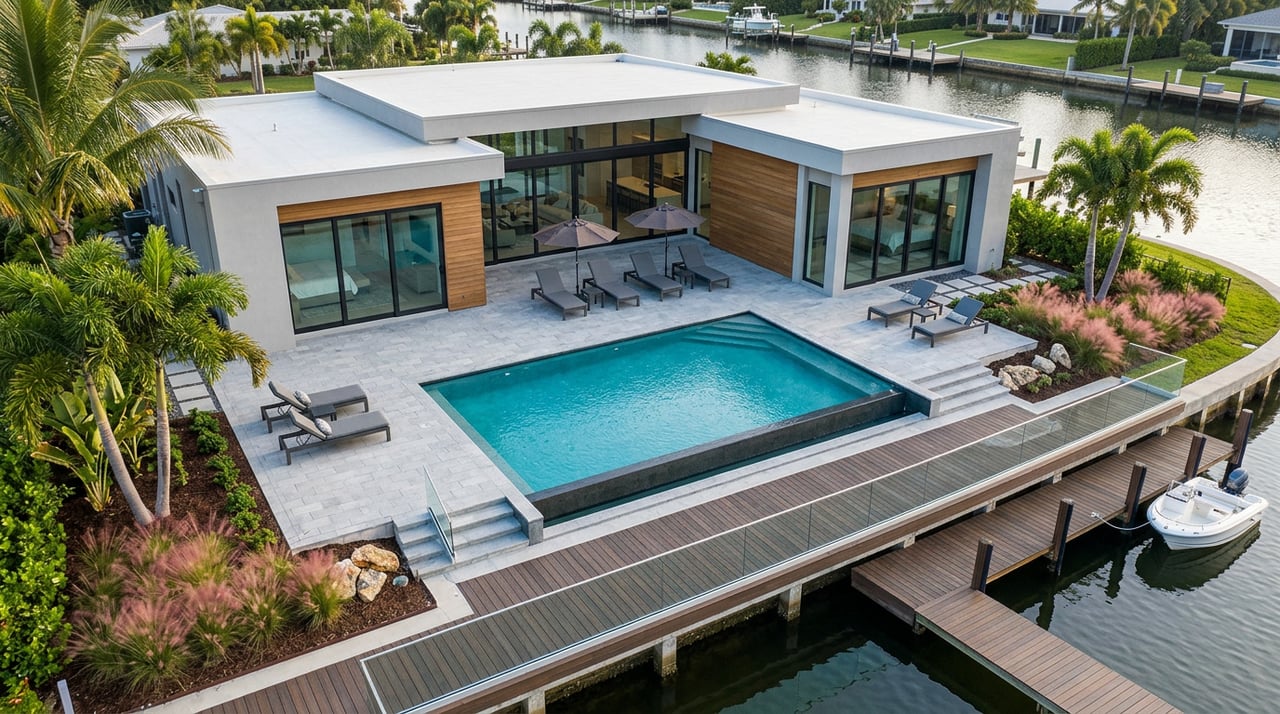
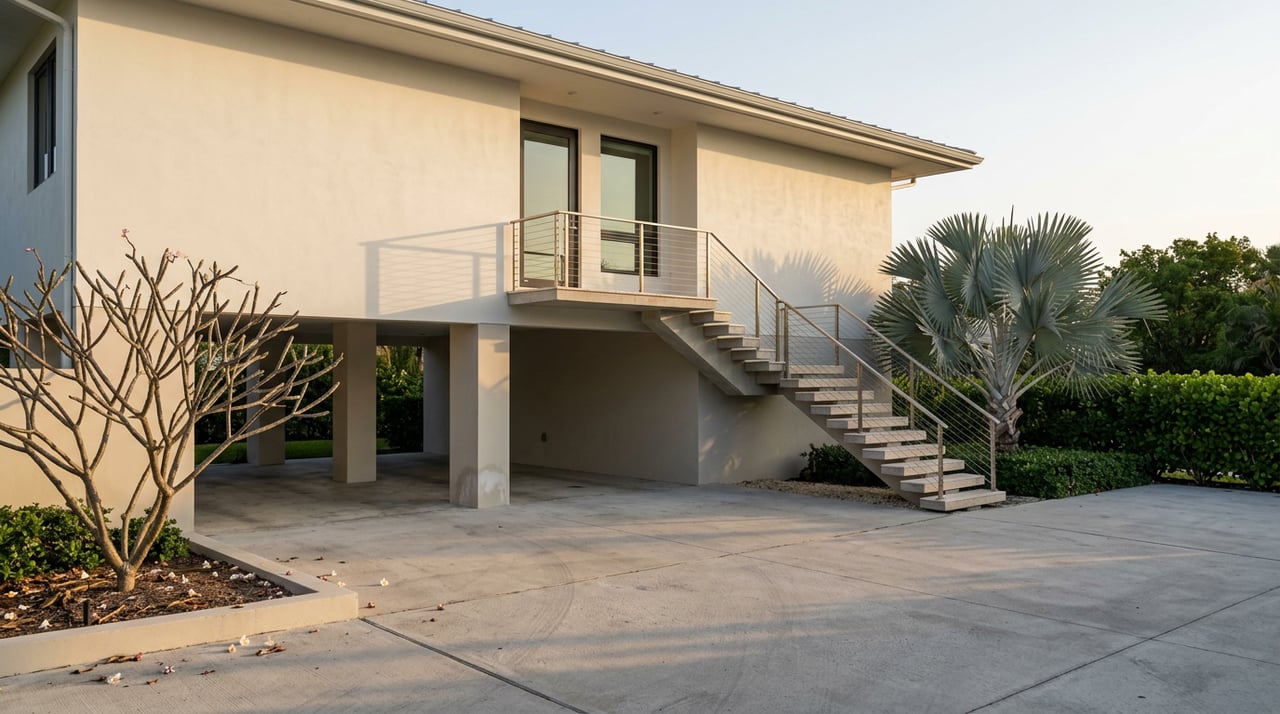
The rebuild that followed is not small. The historic clubhouse, roughly 22,300 square feet, was fully demolished in October 2025 to make way for a new 21,500-square-foot structure with another 3,500 square feet of covered outdoor decks, designed by local firm DSDG Architects and built in the same footprint but elevated to current FEMA standards. Architect Anna Keitel's plans also include underground stormwater vaults, a detail that matters on an island where drainage and flooding are not abstract concerns.
The cost estimate has moved along with the project. Early reporting in 2025 put the number near 20 million dollars. By the time demolition crews finished last October, Longboat Key News was reporting a 27.5 million dollar project. The club's own materials now describe it as a 25 million dollar investment. None of these figures is wrong exactly, they reflect a scope that kept expanding as the design matured, which is worth knowing if you hear residents cite different numbers depending on when they last checked in on the project. The financing is entirely internal: members raised 20 million dollars through a voluntary loan program, with individual loans ranging from 50,000 dollars to several million, all secured by the land, and the remaining 7.5 million dollars is being covered through club operations. New membership now costs 55,000 dollars, up from the prior rate, and the club currently sits at roughly 275 to 280 members out of a capped capacity of 425.
"It started as a renovation, and then after more consideration and thought we realized that to make it FEMA-compliant... a renovation really didn't make any sense."
That quote from Britt, given last fall, still describes where things stand. The original construction estimate was 16 to 18 months from a May 2025 groundbreaking, which lines up with a target somewhere in the fall of 2026. What has changed is the milestone the club is now organizing around. Rather than a quiet soft opening, the stated goal has become hosting the biggest New Year's party Bird Key has ever had. If that holds, the club's actual public debut lands roughly four months later than residents were originally told to expect, and it lands as an event rather than a ribbon cutting.
Six Months Still on the Bridge
The causeway project is a different kind of undertaking, run by a public agency instead of a private club, but it is running on a similarly extended timeline. FDOT's work on State Road 789 between Bird Key and Sunset Drive began in early 2026 and is scheduled to run through early 2027, according to the agency's own project updates. That is a full year of construction, and as of this month, the project is roughly at its midpoint, not its end.
The scope is not cosmetic. FDOT's fact sheet for the 12.3 million dollar project describes dedicated bicycle and transit lanes being added to the bridge, drainage upgrades, and a raised seawall cap near Sunset Drive, work meant to improve resilience along a stretch of roadway that takes regular exposure to surf and storm surge. As part of the same project, palm trees and shrubs on the eastern section of the causeway are being relocated to medians closer to St. Armands Circle, which explains why that stretch has looked sparser than usual this year.
For anyone using the bridge day to day, the practical effects are still active:
- Bike lanes on the causeway remain closed, with cyclists directed to a posted detour rather than the normal shoulder route
- The work zone speed limit is reduced to 35 mph, with fines doubled when crews are present
- Lane closures continue to shift by phase, so the exact configuration on any given week can differ from the week before
- Noise from equipment, pumps, and backup alarms is expected during both daytime and occasional nighttime work
None of this is new information if you have been driving it, but the completion date is worth restating plainly. Early 2027 is still months away. A project that started to feel routine by midsummer is not wrapping up on the schedule that word of mouth might suggest.
Why Both Projects Point the Same Direction
It would be easy to file these as two unrelated headaches, one belonging to the club and one belonging to the county, that happen to overlap by coincidence. Looking at what each project is actually built to withstand suggests otherwise. The yacht club's entire rationale for a full rebuild rather than a renovation was flood compliance and hurricane resilience. The causeway project's core scope items, a raised seawall cap and new drainage, are aimed at the same category of risk: surf, surge, and water that no longer stays where older infrastructure assumed it would.
Bird Key is a low-lying island connected to the mainland by a single causeway, and across these same two years, its most visible private institution and the public bridge that reaches it have both been rebuilt around the assumption that recent storm seasons are the new baseline, not an anomaly to wait out. That is not a small coincidence. It is two different owners, a private club board and a state transportation agency, arriving independently at the same conclusion about what this stretch of coastline now requires.
What This Still Means Through the End of the Year
For residents planning out the rest of 2026, the practical picture is straightforward. The bridge loop, the walk or bike ride that starts at Bird Key Park and crosses the causeway toward St. Armands, is still running under detour conditions and will stay that way into 2027. Bird Key Park itself sits outside the current construction zone and remains the reliable starting point for that route, even while the bridge surface beyond it is still a work site.
The yacht club's actual return to normal is now tied to a New Year's Eve target rather than a late-summer one. If that holds, residents should expect the clubhouse to still look unfinished from the road through the fall, with the real transformation landing all at once around the holidays rather than in stages.
Two rebuilds, one island, and a set of dates worth updating if you were still working off what you heard a year ago.
If you are weighing what any of this means for property values or timing on Bird Key, or simply want a second opinion grounded in what is actually happening on the ground here, Harriet Stopher offers a complimentary home valuation or market consultation for anyone with questions about this stretch of the barrier islands.